This is a 13 year old article about Ogyen Choling - much has changed since then but the basics are the same (comforts are improved as is internet)
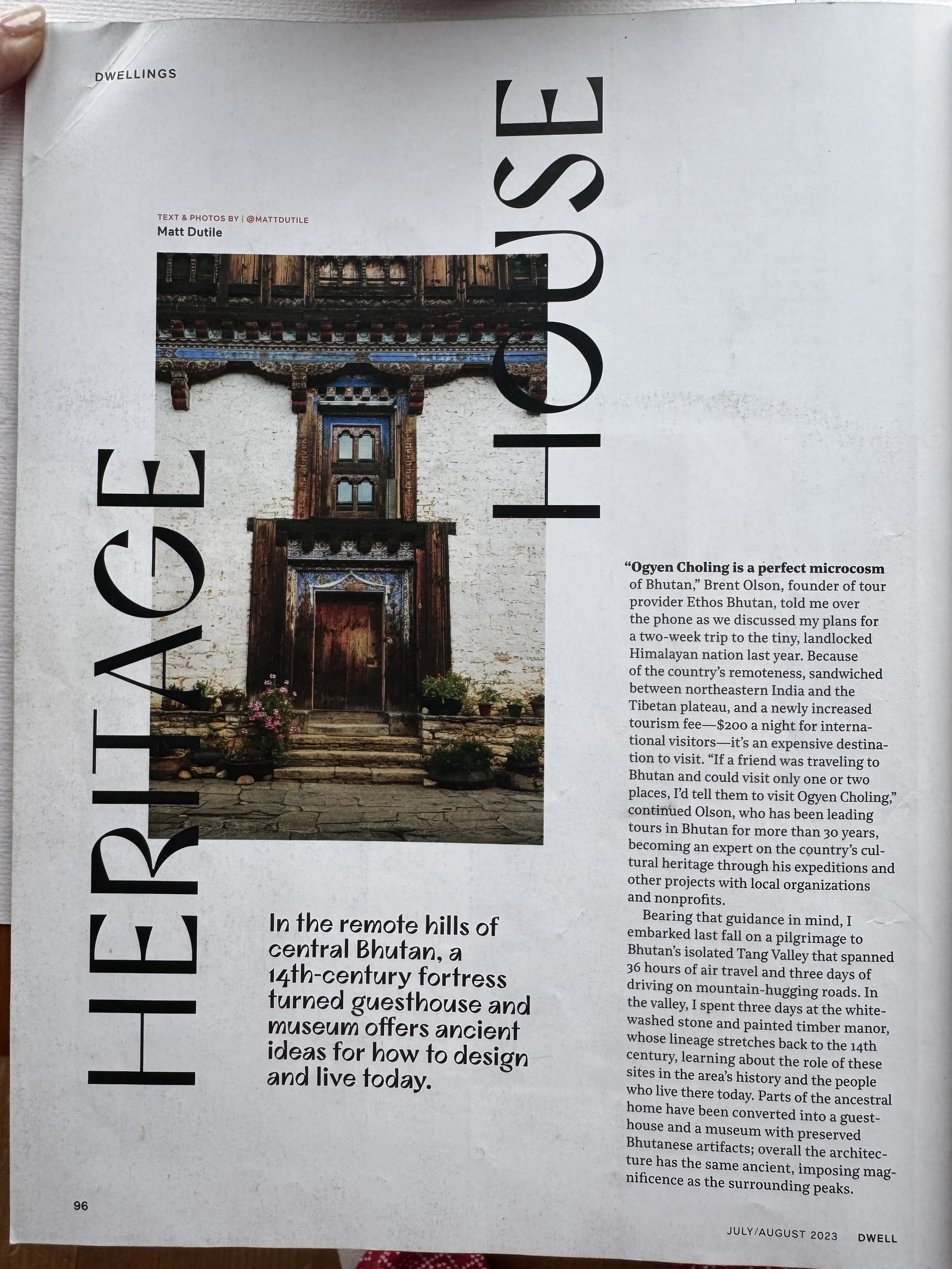
Ogyen Choling featured on Dwell: The Remote 14th-Century Bhutanese Fortress Steeped in Buddhist Heritage
TEXT & PHOTOS BY | @MATTDUTILE
Matt Dutile
In the remote hills of central Bhutan, a 14th-century fortress turned guesthouse and museum offers ancient ideas for how to design and live today.
"Ogyen Choling is a perfect microcosm of Bhutan," Brent Olson, founder of tour provider Ethos Bhutan, told me over the phone as we discussed my plans for a two-week trip to the tiny, landlocked Himalayan nation last year. Because of the country's remoteness, sandwiched between northeastern India and the Tibetan plateau, and a newly increased tourism fee—$200 a night for international visitors-it's an expensive destination to visit. "If a friend was traveling to Bhutan and could visit only one or two places, I'd tell them to visit Ogyen Choling," continued Olson, who has been leading tours in Bhutan for more than 30 years, becoming an expert on the country's cultural heritage through his expeditions and other projects with local organizations and nonprofits.
Bearing that guidance in mind, I embarked last fall on a pilgrimage to Bhutan's isolated Tang Valley that spanned 36 hours of air travel and three days of driving on mountain-hugging roads. In the valley, I spent three days at the whitewashed stone and painted timber manor, whose lineage stretches back to the 14th century, learning about the role of these sites in the area's history and the people who live there today. Parts of the ancestral home have been converted into a guesthouse and a museum with preserved Bhutanese artifacts; overall the architecture has the same ancient, imposing magnificence as the surrounding peaks.
Located in Bhutan's Bumthang District, Ogyen Choling dates back more than 650 years, serving first as a gompa (monastery), then as a dzong (administrative fortress that houses a local lord and fam-ily), and as a nagtshang (manor house) for centuries after. Many of the original structures were leveled in a June 1897 earthquake but were rebuilt to their present state in the years following. Bhutanese author Kunzang Choden, pictured here, marks the 20th generation of her family to live on the estate and care for its heritage; it was passed to her by her father, the complex's prior landlord. She returned to Bhutan permanently in 1996 after yearlong stints in India, Nebraska, the Philippines, and Laos, starting in the '60s. The mural behind her in the two-story tsug lhakhang (temple) is one of the manor's many dedicated to figures like Shakyamuni Buddha, the founder of Buddhism;
Guru Rinpoche, the Buddhist master credited with bringing the religion to Bhutan; Dorji Lingpa, the ancient religious leader of Ogyen Choling; and Gonpo Maning, a local protective Buddhist deity.
Ogyen Choling's four-story utse (central tower) anchors the inner courtyard, which is typical for traditional Bhutanese fortresses.
Ogyen Choling is surrounded by a village of 22 households with mostly farmers and herders. When viewed from the southern fields, it is said, the hill resembles the crest of an elephant, an auspicious Buddhist symbol. According to tradition, this was one of the reasons Tibetan Buddhist master and philosopher, Longchen Rabjam, founded the estate here. experiencing life in the village can feel like experiencing a journey into the past: modern amenities like electricity only reached the area in 2008 with sparse mobile network coverage following in 2010. Before 1984, before the bridge was built over the Tang Chhu River, the only way to reach the village was by a seven hour walk along a mountain path from Jakar, the district capital.
Central Bhutan enjoys cool year round temperatures due to its high altitude. (Tang Valley sits at around 9,186 feet above sea level). To cope with the cooler temperatures the Bhutanese have made chillies an integral part of their cuisine. Brave visitors can try Bhutan’s national dish, ema-datshi, a fiery combination of spicy chillies and cheese made from goat, cow or more frequently yak milk.
Ogyen Choling guests gather for family style meals served on the patio and its adjoining kitchen, where villagers who work on the property turn vegetables from the garden into hearty Bhutanese staples. Choden’s swiss husband cultivates fresh produce in the garden, such as tibia-sized carrotts, tomatoes, leeks and cauliflower.
DWELLINGS
In 2016, Choden and Roder repurposed the L-shaped shagkor enclosing the utse into a guesthouse to support the manor's maintenance costs. The two-story building has eight guest rooms (one shown below) in addition to a dining room. kitchen, and common area. The Ogyen Choling Heritage House also includes four bedrooms in a separate guesthouse, as well as two in an adjoining hermitage. All of the rooms have attached bathrooms with toilets and showers imported from Switzerland. Water is heated by solar energy for every quest room except the two in the hermitage. Traditional Bhutanese architecture employs rammed earth construction, stone masonry, and intricate woodwork around the windows and roofs. All timber work relies on tight joins; structures are built without nails or screws.
Choden converted the utse into Bhutan's first private museum in 2001. "We didn't have a master plan. We just said, One room at a time," she says. "We opened it to the public and then went on repairing the rooms." The museum catalogs the history of the manor and feudal Bhutan with items almost exclusively from the ancestral home, including agricultural tools from the Tang Valley, objects from religious rituals, arms and armor, textiles, masks, and manuscripts, as well as restored family rooms. On the tower's third level, in front of a contemporary artist's mural, baskets of arrows sit alongside helmets and devices for making gunpowder.
Ogyen Choling's museum has one of the, if not the, most complete collections of Bhutanese manor life artifacts from the last few centuries.
The shagkor's plastered-clay walls are painted a vibrant yellow ocher with traditional scenes of Bhutan's four mythical animals: Snow Lion, Tiger, Dragon, and Garuda (an eagle-like bird). In Buddhist mythology, these creatures are the Four Guardians of the cardinal directions and some of Buddha's earliest followers. They also represent the sacred qualities bodhisattvas develop on the path to enliahtenment, including wisdom, generosity, power, and humility.
Detailed frescoes depicting these four creatures commonly adorn the walls of temples and entryways within ancient Bhutanese tortresses.
About an hour and a half's drive from Ogyen Choling, the Choekhar Valley is considered the spiritual heartland of Bhutan, where Buddhism first arrived in the coun try. A group of monks pose (right) at the five-day Jambay Lhakhang festival, which celebrates the namesake temple's founding in the seventh century. The festival launches around midnight with practitioners in decorative masks-and nothing else-performing lercham, or the Naked Dance, in honor of Guru Rinpoche, Bhutan is known for its colorful religious festivals, where locals often share puffed rice, tea and ara (a traditional alcoholic beverage made trom rice or wheat).
The southern edge of the hill on which Ogyen Choling sits offers sweeping views of the Tang Valley and is bedecked with two types of prayer flags, lungdhar and manid-har. The former is composed of colorful squares commonly hung on a diagonal line from high to low between two objects, such as trees or stupas (Buddhist shrines). It's believed the traditional mantras on prayer flags are passed on when the wind ruffles the fabric, which is why lungdhar flags are found blowing in the wind at passes, temples, and bridges in Himalayan nations. The vertical manidhar-most often white but sometimes red, as here-are raised to honor the deceased. A wooden dagger is affixed to their top to help those they commemorate "cut the knot of ignorance."
JULY/AUGUST 2023 DWELL
Bhutan Travel Policy & Visitor Guidelines
Welcome to Bhutan
Bhutan welcomes visitors from around the world while remaining committed to protecting its unique culture, environment, traditions, and way of life.
All visitors are expected to respect Bhutanese laws, customs, communities, and natural surroundings throughout their stay.
1. Visa and Entry Requirements
Visitors must meet Bhutan’s applicable immigration and entry requirements before travelling.
Depending on nationality, travellers may require a visa, entry permit, or other travel authorization. Visitors are responsible for ensuring that their passport and travel documents meet the applicable requirements.
Entry requirements may change, so travellers should check the latest official information before booking or beginning their journey.
2. Sustainable Development Fee
Bhutan applies a Sustainable Development Fee (SDF) to eligible visitors.
The SDF contributes to Bhutan’s long-term sustainable development, including environmental conservation, cultural preservation, healthcare, education, infrastructure, and community development.
Applicable fees, concessions, exemptions, and payment requirements may vary according to nationality and other eligibility criteria.
Visitors should confirm the applicable SDF requirements before travelling.
3. Responsible Travel
Bhutan follows a high-value, low-impact approach to tourism. Visitors are encouraged to travel responsibly and help preserve the country's natural and cultural heritage.
Visitors should:
Respect Bhutanese traditions and customs.
Protect the environment and avoid littering.
Minimise the use of single-use plastics.
Respect local communities and private property.
Support local businesses, artisans, and communities.
Avoid disturbing wildlife.
Follow designated trekking routes and environmental guidelines.
Leave natural and cultural sites as they are.
4. Respect for Culture and Religion
Bhutan's monasteries, temples, dzongs, stupas, and other religious sites are important places of worship and cultural heritage.
Visitors should behave respectfully when visiting these locations.
Please:
Dress appropriately when visiting religious sites.
Follow instructions from guides and site authorities.
Speak quietly and behave respectfully.
Do not touch religious statues, objects, paintings, or artefacts unless permitted.
Ask permission before photographing people.
Follow any photography restrictions.
5. Photography and Drones
Photography is welcomed in many parts of Bhutan, but restrictions may apply at religious, government, military, and other designated locations.
Visitors should always follow local instructions regarding photography and filming.
The use of drones is subject to Bhutanese regulations and may require prior approval or a permit. Visitors should not operate drones without the necessary authorization.
6. Trekking and Outdoor Activities
Bhutan offers a wide range of trekking and outdoor experiences. Visitors participating in trekking or adventure activities should follow all applicable safety requirements.
Travellers should:
Use approved guides and service providers where required.
Follow designated trails.
Respect wildlife and natural habitats.
Carry appropriate clothing and equipment.
Follow the advice of guides, authorities, and local communities.
Take all personal waste with them.
Mountain conditions can change quickly, and visitors should be prepared for changing weather and altitude.
7. Accommodation and Transportation
Visitors should use accommodation and tourism services that meet Bhutan's applicable tourism requirements.
Transportation arrangements should be made through appropriate tourism service providers, hotels, or other authorized providers.
Visitors should follow all safety instructions and local transportation regulations.
8. Wildlife and Environmental Protection
Bhutan is home to diverse and protected wildlife and ecosystems.
Visitors must not:
Feed wild animals.
Capture, harm, or disturb wildlife.
Remove plants, rocks, or other natural resources from protected areas.
Damage forests or natural habitats.
Leave rubbish or other waste behind.
Visitors are encouraged to observe wildlife from a safe and respectful distance.
9. Local Communities
Visitors are encouraged to engage positively with Bhutanese communities. Please respect local customs, homes, businesses, and personal space. When purchasing local products or handicrafts, visitors are encouraged to support local artisans and businesses.
Responsible tourism helps ensure that the benefits of tourism reach communities throughout Bhutan.
10. Health and Travel Insurance
Visitors are encouraged to obtain comprehensive travel insurance before travelling to Bhutan.
Insurance should ideally provide appropriate coverage for medical treatment, emergency evacuation, trip cancellation, baggage loss, and trekking or adventure activities where applicable.
Travellers should also ensure that they have sufficient medication and any necessary medical documentation for the duration of their stay.
11. Compliance with Bhutanese Law
All visitors must comply with the laws and regulations of the Kingdom of Bhutan during their stay.
Visitors are responsible for understanding and following applicable rules relating to immigration, tourism, environmental protection, cultural heritage, wildlife, restricted goods, photography, and public conduct.
Failure to comply with Bhutanese law may result in penalties or other legal consequences.
12. Changes to Travel Requirements
Bhutan's travel policies, visa requirements, Sustainable Development Fee, entry procedures, health requirements, and other regulations may be updated from time to time.
Visitors should always check the latest official information before travelling.
Travel Responsibly. Respect Bhutan. Preserve the Journey.
By travelling responsibly, visitors help protect Bhutan's extraordinary natural environment, cultural heritage, and traditions for future generations.
For updated information on Bhutans Tourism policy and regulation visit: https://bhutan.travel/