I have been dreaming about Portugal for years. Several times I made plans to come, and several times something intervened, the trip postponed, rerouted, cancelled, until Portugal accumulated in my imagination the dreamy weight of a place long desired and never reached. I had a romantic notion of it. Painterly, ancient, suffused with a melancholy light. Fado and azulejos and fishing boats and the particular sadness of a country that was once an empire and lost it all.
The reality, arriving into Lisbon and driving south toward the Algarve on a partly cloudy May Day holiday, is something else. I may have chosen the wrong road, a highway rather than a local road, the kind of driving that shows you a country’s infrastructure rather than its face, but what I see feels unexpectedly dry, spare, deserty in a way that reminds me of Crestone, Colorado, where I once lived. Beautiful in its own way, but not what I had imagined.
The place I am staying is called Wild Oasis, which turns out to be an accurate name. It sits on a hill opposite the village of Monchique, on an unnamed road, in a house with no number. I am here for a drubchö, a Tibetan practice of continuous recitation held over many days, for world peace, led by four masters, at a meditation center a ten-minute walk away. On my first evening I set out on foot to find it.
To reach the gravel road that leads to the center, I have to walk through a cork oak forest.
I have no idea what I am walking into. The ferns are almost taller than me, thick and close, and the evening light, gold and pink, falling at that particular angle that happens only in the last hour before dark, moves through the trees in a way that stops me and I stand there in awe.
I do not know what these trees are.
What I know immediately, without being told, is that I am in the presence of something sacred.
As a painter I notice shapes and the way the light describes them before I notice anything else, and these trees stop me completely. Their canopies spread wide and low, the branches moving in every direction with a kind of arrested elegance, like jazz ballet dancers caught mid-movement and held there, suspended in a gesture of pure expression. There is nothing tentative about a cork oak. The limbs go where they go with complete conviction, and yet the overall feeling is not of agitation but of deep, settled peace. They stand far apart from one another, which allows the evening light to fall between them in long particular shafts. Beneath them, ferns and golden grasses and wildflowers grow in the spaces the trees have left for them. Standing among them feels like standing inside a very old, very quiet cathedral, ancient and roofless and entirely alive.
The first thing I noticed were the dark lines of the thick trunks in the sea of green ferns.
The bark of a cork oak, where it has not been stripped, is deeply textured, gnarled and dense, almost geological. But on many of the trees the bark has been removed from the lower trunk, beginning quite high up, and what is revealed beneath it is one of the most beautiful colors I have encountered in nature. A deep, rich burnt sienna. Not uniform, it varies from tree to tree, moving between a bright luminous orange and a dark red-brown that verges on mahogany, but always warm, always alive, always startling against the sage-green and gray of the upper branches. The contrast between that smooth stripped trunk and the rough textured bark above is extraordinary. As a painter I keep thinking: that color. That specific, unrepeatable color.
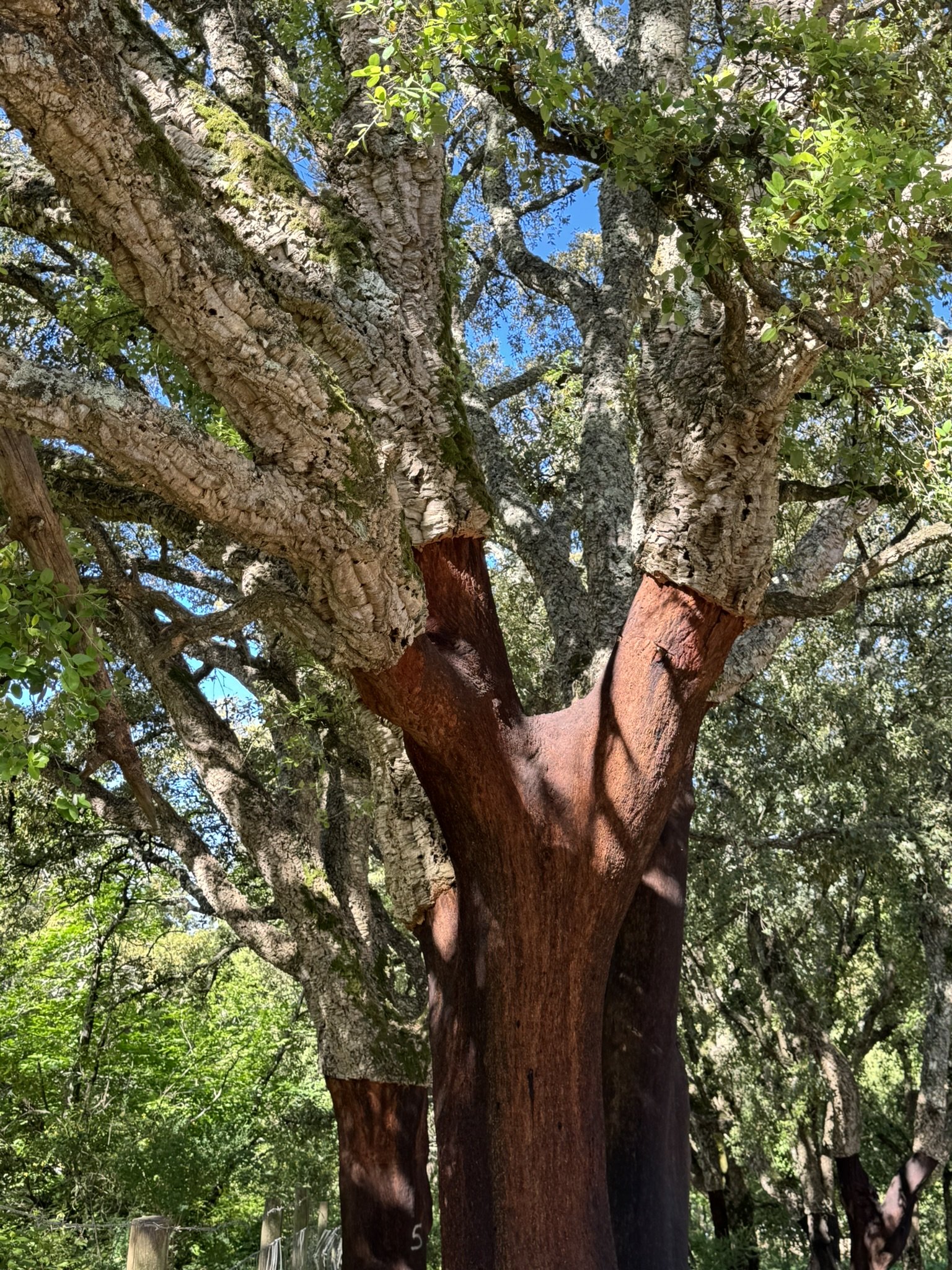
I find some pieces of cork on the ground and pick one up, thinking I can break off a fragment. I cannot. It is stronger than I expect, dense and resilient in a way that seems to contain everything I have already felt standing among these trees, strength, patience, a kind of quiet refusal to be diminished.
Of course, I think. Of course it feels like this.
It is only afterward, back at Wild Oasis, that I read about what I have seen.
The cork oak, if left entirely to itself, would eventually be harmed by its own bark. The accumulation becomes too dense, too suffocating. The tree needs to be stripped to thrive. And so the harvesting, done entirely by hand, with a specialized curved axe, by workers who read each tree individually and pry the bark away in careful panels without ever damaging the living wood beneath, is not an extraction but a collaboration. The tree gives, and in giving is renewed. After each harvest it rests for nine years, Portuguese law sets the minimum, and during that time a date is painted directly onto the stripped trunk in large white numbers indicating the year of the last harvest. There is something graphic and almost designed about these white numbers on the dark sienna trunks, a record kept by the landscape itself.
I have been told, more than once, that I give too much. I am beginning to question that. The cork oak suffocates if it doesn’t give, the bark accumulates until it crushes the very life it was meant to protect. The giving is not the problem. The giving is the renewal. But the tree also knows when it is not ready. It waits nine years between harvests, Portuguese law protecting that minimum, and no one can take from it before its time. What it knows, and what I am slowly learning, is that a generous nature is not a weakness to be corrected but a design to be honored, provided one also knows how to say: not yet. Not now. I am still renewing. The more it gives from fullness, the more it grows back. Stripped to the heartwood and simply growing back, more beautiful each time.
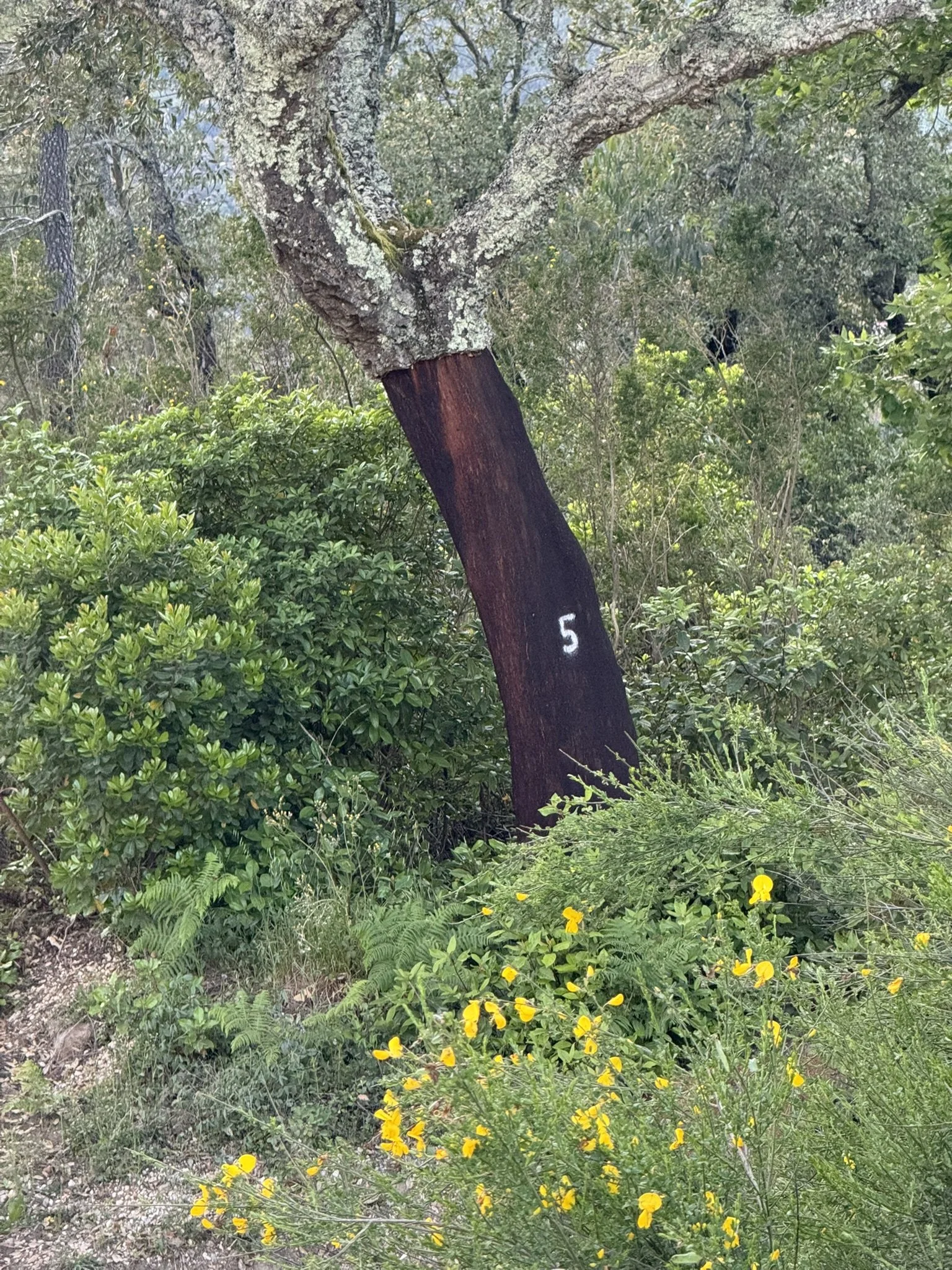
Once harvested, the bark panels are laid out in the open air for six months, stacked in fields, leaning against walls, exposed to sun and rain, curing and flattening in the Portuguese weather. Then they are boiled in large vats of water, which softens them, darkens them, kills anything living inside them, and brings out that warm brown color familiar from every cork you have ever touched. After boiling they are graded by quality. The finest panels, typically from the third harvest onward, when the tree is old enough to produce cork with a fine, even grain, are punched into wine bottle stoppers. Everything else becomes flooring, insulation, shoes, acoustic panels, gaskets. Even the dust and scraps from the punching are compressed into agglomerated cork for bulletin boards and underlayment. The industry wastes almost nothing, a material utilization rate of around ninety-seven percent, which is nearly unheard of in manufacturing.
From harvest to finished wine cork takes roughly a year. Which means the cork in a bottle you open tonight was part of a living tree in Portugal twelve months ago.
A single tree can be harvested fifteen or sixteen times across a lifespan of two hundred years or more. A harvester working a tree today continues a relationship begun before their grandparents were born. And in Portugal you cannot cut down a cork oak, even on your own land, even in your own garden, without permission from the government. This doesn’t feel like bureaucracy. It is respect. It is a society saying: these trees are not ours to destroy.
Portugal produces roughly half of the world’s cork supply, about fifty percent of everything harvested globally comes from this one country’s forests. Cork oak grows across the Mediterranean, but nowhere has the relationship between people and tree been tended with such long careful commitment as here.
I had come to Portugal expecting something entirely different. Instead the landscape reminded me of high desert Colorado, dry and spare and beautiful in its own austere way, but not what I had imagined. It was the cork forest, montado, in the end, that opened Portugal to me. Unexpectedly, on foot, in fading light, on my way to somewhere else entirely.
I do not think my encounter with these trees is accidental. This morning, on the way to the grocery store, I found a whole other montado, and then several more along the road, each one stopping me again with the same force. This rarely happens to me with such strength and such persistence. I am here for nine days of practice, recitation for world peace, and these trees keep appearing as if they have something to say about that intention, or about intention itself. Whether they are protectors or pointers or simply what happens when a landscape meets a mind that is ready to receive it, I cannot say. I only know that I arrived in Portugal down hearted, and the cork oaks, sobreiros, found me, and my being shifted.
Today we held the first session of the drubchö, a blessing of the land, four Tibetan masters and a gathering of students from across the world, sitting together on a mountain top in Portugal to recite prayers for world peace. During the ceremony one of the teachers performed a lama dance in the shrine room, moving through the space with his practice implements raised, the evening light falling gold across his face. In the slow, smooth, almost otherworldly turns of that dance, for one moment, I saw a cork oak, a magnificent one, fully alive, every limb moving with complete conviction and complete peace. As if one of the trees had simply walked in from the forest and joined us.
Tomorrow the practice begins in earnest, eight days of continuous recitation from early morning until evening. Outside, the sobreiros stand in the changing light, patient, particular, entirely themselves.
I am grateful to these trees. To their patience, their silence, their deeply particular color, the way they hold the light, the way they stand apart from each other, with natural knowing that some things need space to be fully seen. I did not come looking for them. But I found them, and they gave me everything I had hoped for, that feeling of encountering something ancient and alive and entirely itself, something that has been quietly doing what it does for centuries and will go on doing it long after I have passed through.
That is what a cathedral is for.
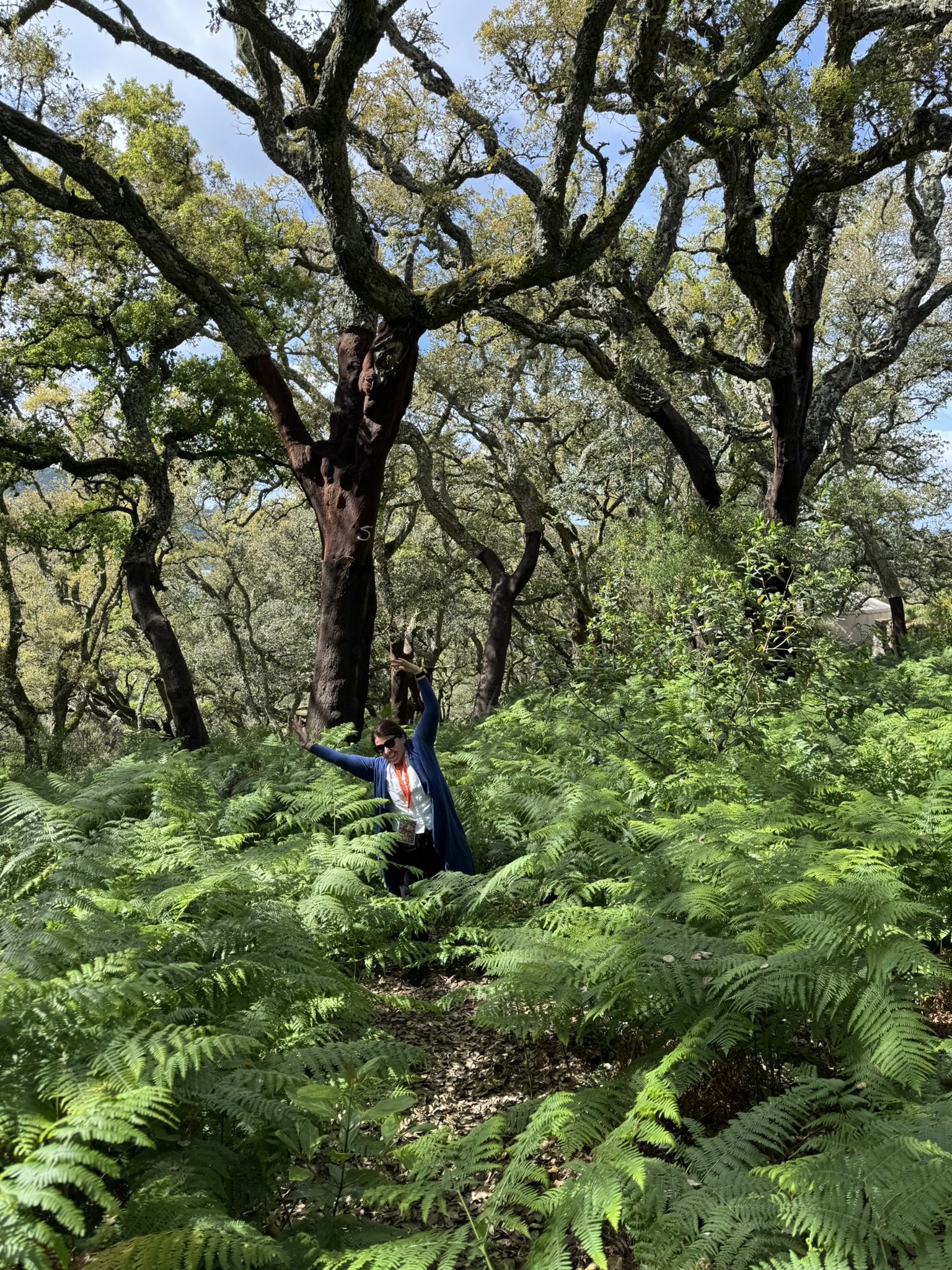
Dancing with the oaks
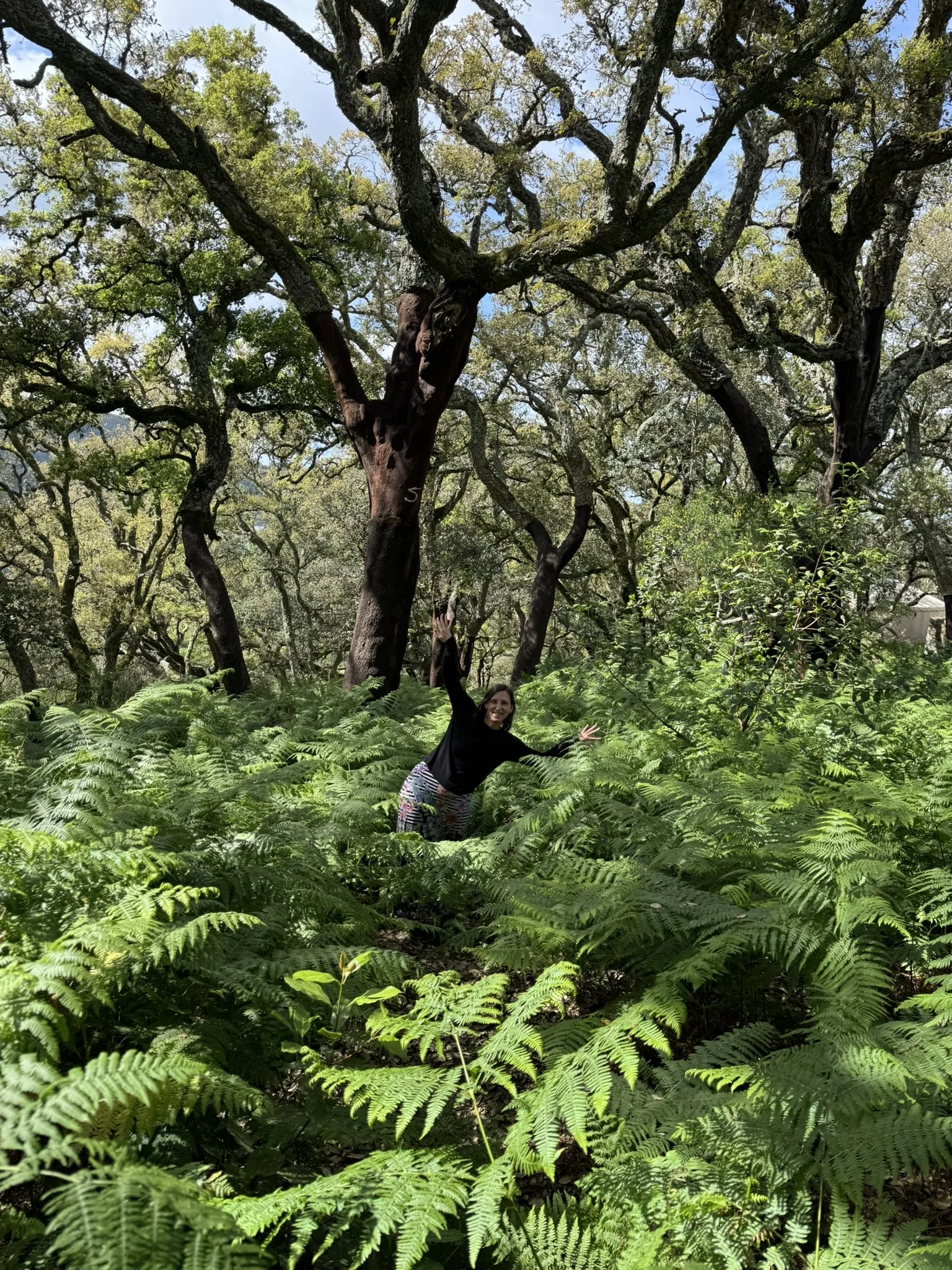
Lauren dancing with sobreiros